
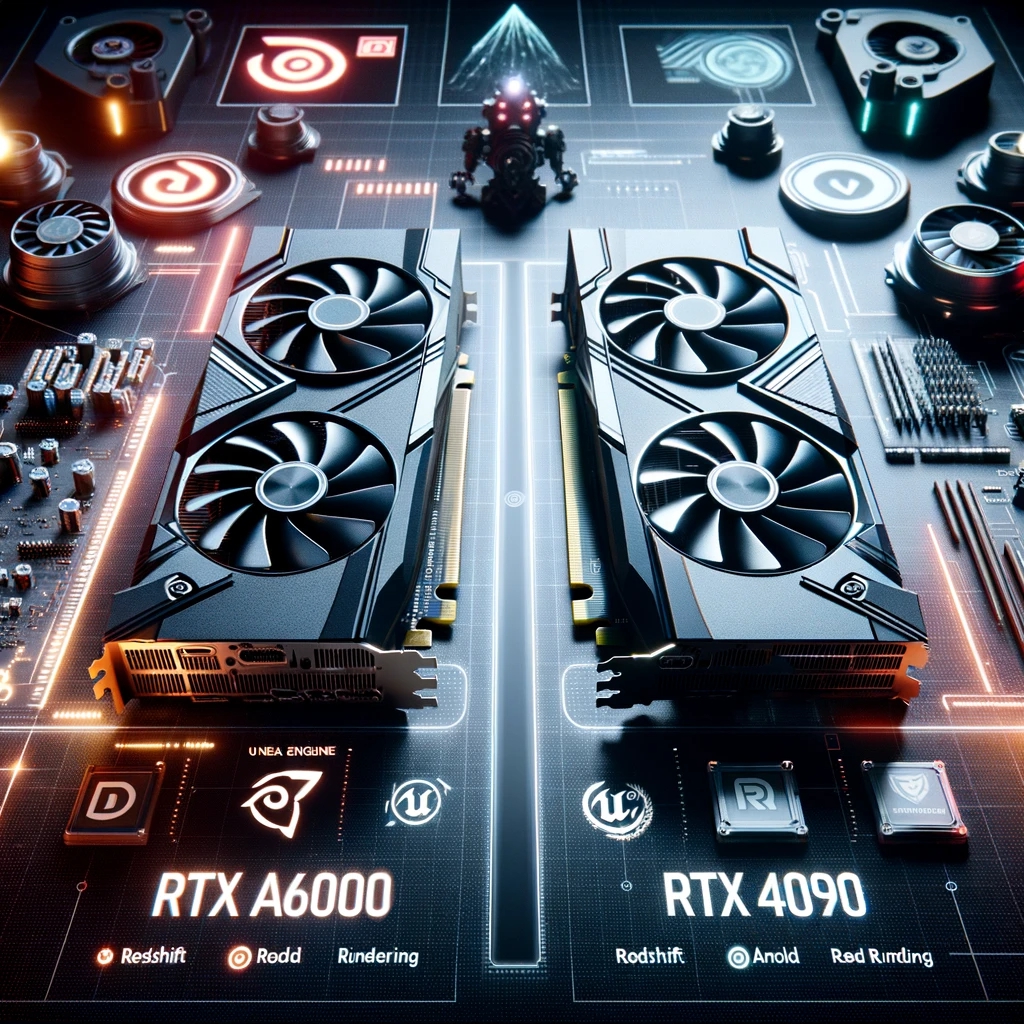
When it comes to high-end graphics processing, Nvidia’s RTX A6000 and RTX 4090 are two powerhouses that stand out. Both cards are designed to handle intensive tasks like 3D rendering, but they cater to slightly different markets. In this post, we’ll compare these GPUs in the context of their performance with Unreal Engine, Redshift rendering in Cinema 4D, and Arnold rendering in Maya.
Architecture and Performance
RTX A6000
check price on Amazon
- Target Audience: Primarily designed for professional workstations.
- Architecture: Based on the Ampere architecture, it excels in rendering tasks and computational workflows.
- Memory: Comes with a massive 48 GB of GDDR6 memory, which is highly beneficial for complex scenes and large textures.
RTX 4090
check price on Amazon
- Target Audience: Aimed at high-end gaming and consumer-level content creation.
- Architecture: Built on Nvidia’s latest architecture (as of the time of this comparison), it offers exceptional performance in both gaming and creative tasks.
- Memory: Equipped with less memory than the A6000, but its faster GDDR6X memory provides a significant speed advantage in many scenarios.
Compatibility with Unreal Engine
Unreal Engine is known for its real-time rendering capabilities, especially in game development and architectural visualization.
- RTX A6000: Offers stable performance with excellent memory capacity, which is crucial for large-scale environments and detailed textures in Unreal Engine. Its professional-grade drivers ensure reliability during long rendering sessions.
- RTX 4090: Delivers faster frame rates and real-time ray tracing performance. This makes it ideal for interactive applications and VR experiences developed in Unreal Engine.
Performance in Redshift Rendering (Cinema 4D)
Redshift, a popular GPU-accelerated renderer for Cinema 4D, benefits significantly from powerful GPUs.
- RTX A6000: Its large memory pool is a major advantage for Redshift, particularly when dealing with complex scenes with high-resolution textures and vast geometry.
- RTX 4090: Offers superior raw performance, translating to faster render times. However, its smaller memory might limit its ability to handle extremely large and complex scenes.
Efficiency in Arnold Rendering (Maya)
Arnold is a widely used CPU-based renderer in Maya, but recent updates have introduced GPU rendering capabilities.
- RTX A6000: The card’s focus on workstation-grade tasks makes it a reliable choice for Arnold’s GPU rendering. Its expansive memory allows for rendering intricate scenes without memory bottlenecks.
- RTX 4090: Shines in terms of speed, reducing render times significantly. However, for extremely memory-intensive scenes, it might fall short compared to the A6000.
Price and Availability
- RTX A6000: Generally more expensive, catering to professional and commercial users who require the stability and memory capacity it offers.
- RTX 4090: More affordable, making it an attractive option for individual creators and small studios.
Conclusion
Choosing between the RTX A6000 and RTX 4090 depends largely on specific needs and workflows. For professionals working with extremely large and complex scenes, particularly in a commercial setting, the RTX A6000’s stability and memory capacity make it a formidable choice. On the other hand, the RTX 4090 offers a more cost-effective solution with impressive performance, especially suitable for individual creators and smaller studios. In the end, both GPUs are exceptional choices but cater to different requirements in the realms of Unreal Engine, Redshift, and Arnold rendering.
 CG Gains
Leave a comment